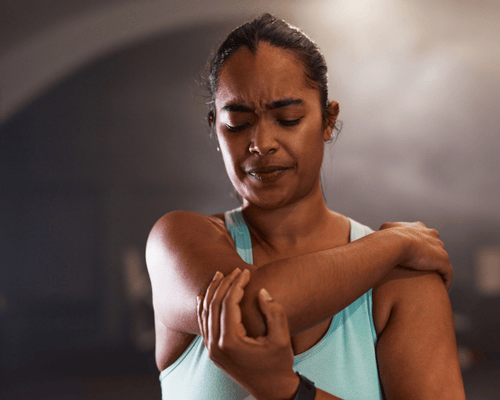
If you have suddenly started waking up with aching hips, stiff fingers, or a sore back, you are not alone. Joint and muscle pain is one of the most commonly reported, and often most surprising, symptoms of perimenopause. It can begin at different times, with some women first noticing changes around age 40. These new aches can be worrying and disruptive, especially if you are used to an active lifestyle.
This blog aims to explain what is happening in your body to cause this discomfort and, most importantly, explore the practical and effective strategies you can use to manage it, find relief, and stay active. It also covers the story of Caroline, a Forth customer who used our MyFORM® Perimenopause Blood Test to help her understand her hormones and the perimenopausal transition.
Why Causes Joint Paint During Perimenopause?
Perimenopausal joint pain, sometimes called ‘menopausal arthritis’, typically presents as stiffness, aches, and soreness in the joints-such as the hips, knees, lower back, and hands. It often feels worse in the morning and can ease as the day goes on.
The primary driver behind this is hormonal fluctuation, specifically the decline of oestrogen. Oestrogen plays a vital role in our joint health:
It has an anti-inflammatory effect: As oestrogen levels fall, general inflammation can rise, leading to pain and stiffness in and around the joints.
It protects cartilage: Oestrogen is believed to help maintain the health and hydration of cartilage, the connective tissue that cushions your joints.
It supports connective tissues: Hormones also influence the health of tendons and ligaments.
This discomfort can be debilitating and affect activities you once loved. For Caroline, a keen runner who had discovered a passion for exercise in her mid-30s, the onset of lower back, pelvic, and hip pain was severe. Caroline told us how It impacted her life:
"At first, the pain completely stopped me from running. The lower back pain especially was unbearable, and the only way to relieve it was to stop altogether. But this had a huge impact on my mental health. Running had been the key to feeling the best I ever had mentally, so not being able to do it took its toll. I could feel myself slipping back into old anxious habits, and it was a difficult period to navigate."
Caroline - Forth Customer
We asked Dr. Thom Phillips, GP and BMS Certified Menopause Specialist, for his view on this common symptom.
"Joint pain is a frequent and often surprising symptom of perimenopause that patients report. It is vital to validate this experience-it is a real, physiological event, not just 'in your head.' These aches are often linked to hormonal shifts, but it is also essential to rule out other conditions like inflammatory arthritis. I strongly encourage anyone experiencing persistent pain to discuss it with their doctor to get a correct diagnosis and explore management options."
Finding relief is often about a multi-faceted approach, combining movement, lifestyle changes, and medical support.
1. Adjust Your Approach to Movement
It feels like a paradox: exercise hurts, but a lack of movement can make stiffness worse. The key is to adapt your activity to support your joints, not strain them.
Embrace Low-Impact Exercise: Activities like swimming, cycling, and walking put less stress on the joints..
Prioritise Strength Training: This is perhaps the most important change you can make. Building muscle helps to support and protect your joints. It also boosts metabolism and has a positive impact on mental health. Strength training can also help women protect against osteoporosis.
Focus on Flexibility: Gentle stretching, yoga, or Pilates can improve flexibility, reduce stiffness, and help with balance.
Listen to Your Body: This may mean pausing a high-impact activity for a while.
"I accepted that I needed to pause running for a while, as it was causing too much pain — but I was determined it wouldn’t be forever.
Instead, I turned to strength training. I learned that building and maintaining muscle mass helps support the joints, which in turn supports running. It also boosts metabolism and has a positive impact on mental health. Around the same time, I learned how to swim — a lower-impact activity that’s kinder to the joints — and I took up yoga and walking. I also started cycling more, again choosing activities that reduced strain on my body.
These adjustments paid off. In time, I was able to start running again and even completed the Couch to 5K program for a second time. I’m now fitter than I’ve ever been, and the strength I’ve built has made a real difference to my running performance. I also have other forms of exercise to fall back on when my back pain flares up — which it still does from time to time — but I can manage it much better now, both physically and mentally."
Caroline - Forth Customer
2. Lifestyle and Dietary Adjustments
Anti-inflammatory Diet: Focus on foods rich in omega-3s (like oily fish, flaxseeds, and walnuts), leafy greens, fruits, and whole grains. Try to reduce processed foods, excess sugar, and alcohol, which can all promote inflammation.
Stay Hydrated: Water is essential for keeping cartilage and connective tissues hydrated and healthy.
Maintain a Healthy Weight: Any excess weight puts additional strain on load-bearing joints like the knees and hips. Losing even a small amount of weight can make a significant difference to pain levels.
Consider Supplements: Some women find relief with supplements like magnesium (for muscle relaxation), turmeric (for inflammation), or a high-quality omega-3. Always check with your doctor before starting new supplements.
"As well as the undoubted mental and physical benefits of regular exercise, movement stimulates synovial fluid production, naturally lubricating joints. An anti-inflammatory diet rich in omega-3 fatty acids, colorful vegetables, berries, and turmeric can significantly reduce joint inflammation. Adequate protein supports cartilage repair, while maintaining healthy weight reduces stress on weight-bearing joints. Staying hydrated keeps cartilage supple. Avoiding inflammatory foods like excess sugar and processed items prevents symptom exacerbation. Together, these strategies can markedly improve joint comfort and mobility during perimenopause."
Talk to Your GP: Your first step should be to discuss your pain with a doctor to rule out other causes, such as osteoarthritis or rheumatoid arthritis.
Physiotherapy: A physiotherapist can assess your pain and provide specific, targeted exercises to strengthen the muscles supporting your affected joints.
Pain Relief: For flare-ups, over-the-counter anti-inflammatory medication (like ibuprofen) may help, but it is not a long-term solution.
Hormone Replacement Therapy (HRT): For many women, replacing the lost oestrogen with HRT can directly address the root cause of the joint pain, often leading to a significant improvement [3]. This is a treatment that requires a full discussion of your personal benefits and risks with a healthcare provider.
"Several supplements have shown promise for alleviating perimenopausal joint pain. Omega-3 fatty acids (fish oil) reduce inflammation and joint stiffness effectively. Glucosamine and chondroitin support cartilage health and may slow degradation. Curcumin (turmeric extract) offers potent anti-inflammatory benefits, especially when combined with black pepper for absorption. Vitamin D is crucial for bone and joint health; deficiency commonly worsens symptoms. Magnesium helps muscle relaxation and reduces inflammation. Collagen peptides support cartilage repair and joint flexibility. Boswellia (frankincense) provides natural pain relief. While these supplements can be beneficial, quality matters significantly—choose reputable brands with third-party testing"
“Don’t give up. Joint pain is a common challenge for women going through perimenopause, but it doesn’t have to mean the end of your fitness journey. If you’re already active, you might just need to adjust your routine to better support your joints and ligaments. And if you’re new to exercise, I can’t recommend strength training enough — not only does it build fitness and confidence, but it’s also essential for maintaining bone density and reducing the risk of osteoporosis.” – Caroline
Perimenopausal joint pain can be a challenging and unwelcome surprise, but it is a real physiological response to your changing hormones. The most important takeaway is that it is manageable.
Through a thoughtful combination of appropriate movement, lifestyle adjustments, and medical support, you can find relief. As Caroline’s story shows, it may require you to adjust your routine or lifestyle, but it does not have to mean the end of an active and healthy life.
Frequently Asked Questions
How do I know if my joint pain is perimenopause or arthritis?
While perimenopause can cause joint pain (arthralgia), it is vital to get a proper diagnosis from a doctor. They can run tests to distinguish between hormonally-driven pain and inflammatory conditions like rheumatoid arthritis or the ‘wear and tear’ of osteoarthritis, which can also begin in mid-life.
Can HRT really help with joint pain?
Yes, for many women, it can. Because the pain is often linked directly to the loss of oestrogen’s anti-inflammatory and protective effects, replacing that oestrogen via HRT can significantly reduce or even eliminate the symptom.
What is the single best exercise to start with?
If you are in pain, start with something gentle and low-impact, like swimming or walking. However, the most beneficial exercise to add to your routine for long-term joint and bone health is strength training. This does not mean heavy weightlifting; it can start with bodyweight exercises or using light resistance bands.
Will this joint pain go away after menopause?
Experiences vary. For some women, the pain eases once their hormones stabilise post-menopause. For others, the pain persists, often because the low-oestrogen state is now the new normal. This is why building sustainable management strategies, like strength training and a healthy diet, is so important.
What foods are known to make joint pain worse?
While triggers are individual, common culprits that can increase inflammation include processed foods, high-sugar snacks and drinks, refined carbohydrates (like white bread), and sometimes, for sensitive people, red meat and dairy.
MyFORM® Perimenopause Test
Breakthrough test
MyFORM® Perimenopause Test
Understand if symptoms you're experiencing could be due to perimenopause with our ground-breaking hormone mapping test.
This information has been medically reviewed by Dr Thom Phillips
Thom works in NHS general practice and has a decade of experience working in both male and female elite sport. He has a background in exercise physiology and has published research into fatigue biomarkers.
We use cookies on our website to give you the most relevant experience by remembering your preferences and repeat visits. By clicking “Accept”, you consent to the use of ALL the cookies. Not consenting or withdrawing consent, may adversely affect certain features and functions.
Functional
Always active
The technical storage or access is strictly necessary for the legitimate purpose of enabling the use of a specific service explicitly requested by the subscriber or user, or for the sole purpose of carrying out the transmission of a communication over an electronic communications network.
Preferences
The technical storage or access is necessary for the legitimate purpose of storing preferences that are not requested by the subscriber or user.
Statistics
The technical storage or access that is used exclusively for statistical purposes.The technical storage or access that is used exclusively for anonymous statistical purposes. Without a subpoena, voluntary compliance on the part of your Internet Service Provider, or additional records from a third party, information stored or retrieved for this purpose alone cannot usually be used to identify you.
Marketing
The technical storage or access is required to create user profiles to send advertising, or to track the user on a website or across several websites for similar marketing purposes.